Why Consumers Deserve More Answers Before Placing a Deposit
By Ricardo Rodriguez-Long
I have watched startups rise and collapse. I have watched established manufacturers stumble and recover. I have seen the full cycle of automotive hype, and I have developed a reliable internal alarm for when a story is being sold rather than told.
That alarm has been going off since the first wave of Slate EV truck coverage hit my feed.
I want to be precise about what I am not saying. I am not saying Slate is a bad truck. I am not saying the company is dishonest. I am not saying consumers should avoid it. What I am saying — what my four decades of professional experience compel me to say — is that most of the media coverage surrounding this vehicle has been repeating a marketing narrative, not performing journalism. And consumers deserve better.
The Words Are Perfect. That’s the Problem.
Read any of the mainstream articles on the Slate truck, and you will find the same vocabulary: affordable, American-made, simple, innovative, disruptive. Those are genuinely attractive words. They are also not coincidentally exactly the words a sophisticated public relations department would select. When every major outlet lands on the same five adjectives, that is not independent journalism converging on the truth. That is a press release doing its job.
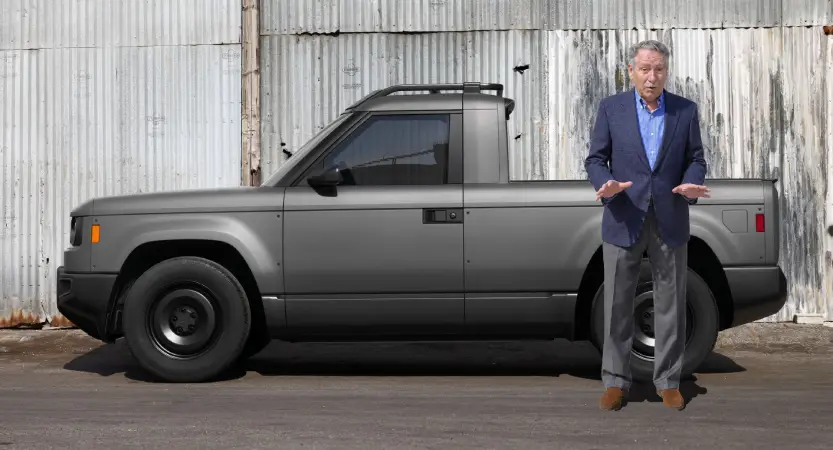
The Slate truck has been described as a “$20,000 American electric pickup.” That number requires significant context. The $20,000 figure assumed maximum federal tax incentives that many buyers may not qualify for. Before incentives, the base price is closer to $24,950, with destination charges pushing the actual starting transaction price toward $26,500. For buyers who cannot access the full federal credit, the gap widens further. MotorTrend’s report put the realistic pre-incentive figure at approximately $26,500, before any options or accessories.
That distinction matters enormously because affordability is Slate’s entire value proposition. If the affordability story requires conditions that a significant percentage of buyers cannot meet, that is not a footnote. That is the story.
Who Is Actually Behind Slate?
Slate did not emerge from a garage, a university engineering lab, or the kind of nerd startup mythology the coverage implies. The company was incubated inside Re:Build Manufacturing, an advanced manufacturing platform focused on batteries, electrification, aerospace, defense supply chains, automation, and domestic industrial development. Re:Build was co-founded by Jeff Wilke, the former CEO of Amazon Worldwide Consumer and one of the principal architects of Amazon’s modern operational and logistics infrastructure. Slate’s current CEO, Peter Faricy, is also a former Amazon executive. A remarkable number of the company’s key people carry Amazon backgrounds.
None of that is inherently problematic. Experienced operators building industrial companies is how economies grow. But the Amazon-executive concentration is a legitimate contextual detail that almost no coverage has explored. Because understanding who built a company, how they think, and what their broader objectives are is essential to understanding what the company is and where it is actually going.
Re:Build’s stated mission is to revitalize American manufacturing through electrification and advanced technology. It operates across sectors that align precisely with current U.S. industrial policy priorities: domestic manufacturing, battery supply chains, supply-chain independence, Midwestern industrial investment, and workforce development. Slate checks every single one of those boxes. The company’s planned manufacturing facility in Indiana, its battery supply agreement with SK On (a Korean company) is for” U.S.-built cells”, and its consistent messaging around American jobs and domestic production places it directly inside the political and policy conversation of this era.
To be factual: I found no evidence of improper government support or existing major federal contracts. But a company structured this way is naturally positioned to pursue state tax incentives, workforce grants, manufacturing credits, infrastructure assistance, and battery-supply incentive programs. That is not a scandal. That is an industrial strategy. And it fundamentally changes the story from “affordable truck startup” to “a new model for American industrial development, where private capital, former technology executives, advanced manufacturing, and industrial policy converge into a single business platform.” That is a more interesting and more honest story. It is also the one nobody seems to be telling.
What Hasn’t Been Disclosed
Here is where my journalistic instinct sharpens into something specific. Slate has disclosed its battery supplier: SK On of South Korea, which will provide NMC-chemistry cells under a supply agreement through 2031. That is meaningful transparency. The battery pack is confirmed at 65 kWh gross, 63 kWh usable, with 205 miles of EPA-estimated range, 120 kW DC fast charging, 11 kW AC charging, and NACS connector.
But Slate has not publicly identified the manufacturer of its electric motor. The company has disclosed performance figures — 201 horsepower, 195 lb-ft of torque, rear-wheel drive — without identifying the motor manufacturer, the inverter supplier, or the drive unit supplier. For an established OEM with decades of production history and millions of vehicles in service, undisclosed supplier details might be unremarkable. For a startup that asks consumers for non-refundable deposits before a single production vehicle has been delivered to a paying customer, it is a legitimate journalistic question.
I would ask Slate, “Who makes your motor?” Is it sourced domestically, in South Korea, in Europe, or in China? Who makes your inverter? Is the motor a permanent magnet design or induction? What rare-earth materials are in the supply chain? And perhaps most urgently: what is the projected replacement cost of the battery pack? What is the projected replacement cost of the motor and drive unit? Those numbers will define the true long-term cost of ownership, and they have not been disclosed.
I should also note the choice of battery chemistry, because it is telling. Many analysts initially assumed Slate would use low-cost LFP chemistry, widely deployed across Chinese EVs for its durability and lower replacement cost. Instead, Slate selected NMC. NMC delivers higher energy density and a lighter pack, but it is more expensive, uses nickel and cobalt, and typically carries a higher replacement cost. For a vehicle whose entire marketing proposition is built around low price, choosing more expensive battery chemistry is a decision that deserves explanation rather than silence.
The Chinese Comparison Nobody Wants to Make
I study global automotive markets professionally. I follow Chinese manufacturers not because they are fashionable to discuss, but because ignoring them means telling an incomplete story about where the industry is going.
When I examined the specifications of Chinese electric pickups currently available in their domestic market, I found something the American media has largely declined to report. The Radar RD6, manufactured by Geely Riddara, offers 250 to 390 miles of range, 2,200 pounds of payload capacity, a modern passenger-car interior, available AWD, and standard vehicle-to-power load export — at approximately $20,000 in the Chinese market before local incentives. The Maxus T90 EV from SAIC, the Dongfeng Rich 6 EV, and the JAC T8 EV offer comparable specifications in similar price ranges, all with larger batteries, higher payload ratings, better interiors, better suspension, and more comprehensive technology packages than Slate currently offers.
This is not an argument for importing Chinese trucks. I understand the tariff realities. I understand the political climate. I understand the supply-chain, regulatory, and safety certification barriers. But it is an argument for context. Journalists should be explaining to consumers that “an affordable no-frills electric truck” is not an American innovation. It is a product category that Chinese manufacturers have been developing and refining for years. Slate’s genuine innovation, if it succeeds, would be proving that a radically simplified vehicle can be manufactured profitably inside the United States at competitive cost. That would be a meaningful achievement. But it is not the same thing as being the first to conceive of a basic electric truck, and fusing the two does consumers a disservice.
The Weight of History
I remember Bricklin. I remember Delorean. I remember Fisker — both versions of Fisker. I remember Coda, THINK, Bright Automotive, Aptera, Canoo, Lordstown Motors, and the long list of electric-vehicle startups that generated enormous press coverage, significant investor enthusiasm, and heartfelt consumer deposits before encountering the brutal economics of manufacturing automobiles at scale. Even PoleStar (with huge backing from its Chinese owner) pulls the plug on the USA. Some of those stories ended in bankruptcy courts. Some ended in consumer lawsuits. Some ended in congressional hearings. A few survived in diminished form.
I am not predicting that outcome for Slate. But history demands that I acknowledge the pattern and ask whether consumers invited to place non-refundable deposits today have been given a clear-eyed picture of the risks they are accepting. Because a startup deposit is not the same as a Ford or Chevrolet purchase order. It carries startup risk: manufacturing delays, parts scarcity, service-network limitations, warranty processing capacity, resale-value uncertainty, and the fundamental question of whether the company will reach sufficient scale to sustain itself as an independent entity.
Those risks are not hypothetical. They are documented experiences from multiple companies over the past 15 years in the United States EV industry.
What Journalism Is For
Our job is not to help manufacturers sell vehicles. Our job is to help consumers make informed decisions. Those are not the same objective, and confusing them is a professional failure.
Before placing a non-refundable deposit on a Slate truck, every consumer should have independent, verified answers to specific questions: What is the final transaction price, including destination and documentation fees, before any incentives? What is the realistic delivery window, and what happens to the deposit if that window is missed? Where will warranty work be performed, and what is the service center density at launch? What are the replacement costs of the battery, motor, and drive unit? What is Slate’s financial position, and how many vehicles must it sell to remain viable? What does the cancellation policy actually say in the legal language, not the marketing language? What is the expected value of depreciation?
These are not hostile questions. They are the basic due diligence that any responsible consumer advocate would perform before committing money to any significant purchase — let alone an unproven vehicle from an unproven manufacturer operating in the most capital-intensive and operationally complex industry in the world.
Slate’s preorder deposit is $300 and is explicitly designated as non-refundable. That is not a trivial commitment to ask of a customer before a vehicle has entered production. The journalism surrounding that commitment should reflect its weight.
What I Actually Hope For
I genuinely hope Slate succeeds. More competition in the entry-level vehicle segment benefits consumers. Lower prices benefit working families. Domestic manufacturing jobs benefit communities. A proven case that simplified electric vehicles can be built profitably in America benefits the broader industry. I want all of those outcomes.
But hope is not journalism. Public relations is not journalism. Repeating the press release and accepting gifts is not journalism.
Journalism is asking the difficult question before the money changes hands, not after. Journalism provides the context that turns a press briefing into a complete picture. Journalism is telling consumers what they are buying, who is actually selling it, what the real risks are, and what the global marketplace really looks like.
The Slate truck may be exactly what it claims to be. It may become the affordable, reliable, American-made electric truck that hundreds of thousands of buyers have been waiting for. I hope it is.
But until it has proven manufacturing at scale, demonstrated parts availability and service capacity, established real-world reliability data, and built a resale market that protects buyers’ equity, consumers deserve more than enthusiasm.
They deserve the full story. And it is our job to tell it.